 |
| Charley Peters, Sketches for Pyschoparadoxa (2011), Ink on paper |

Showing posts with label 2011. Show all posts
Showing posts with label 2011. Show all posts
Monday, 28 November 2011


Sunday, 27 November 2011

Tuesday, 15 November 2011

Monday, 14 November 2011
Studio Views: Work in Progress, Autosuggestion
 |
| Charley Peters Autosuggestion (detail) (2011), Duct tape on wall |
This is the latest work in the ongoing series of wall drawings in duct tape. It develops previous pieces where architectural features intervene with drawn lines by working across floor spaces, ceilings, and, as in this case, around a corner of a room. It is interesting for me to move the disrupted lines drawn on paper in works such as Interruptions (http://www.charleypetersprojects.com/2011/09/studio-views-work-in-progress.html) into real locations, using a physical material such as duct tape to draw with. When being used as a drawing medium the tape moves across both two and three dimensions to delineate lines and spaces. It has the resiliance to be manipulated across a room's different surfaces and visual planes to make a multi-dimensional drawing in space.
 |
| Charley Peters, Autosuggestion (2011) |
Monday, 7 November 2011
Project News: Future of the City
 |
| Charley Peters, Future Cities (2011), London |
The work I produced recently for Smart Urban Stage is now online on the Future of the City pages of the website. In the project, Professor Gordon Wagener, Head of Design, Mercedes-Benz, Stuttgart asked eight international artists and designers to respond to the question, 'In reference to urban mobility, how will design evolve in the upcoming two decades?'
The work I made translated my studio practice into a series of ephemeral drawn interventions in London. I am interested in the lines of movement within the city, and how, as cities continue to grow in the future, the paths of motion of the wandering flaneur intersect the transit of automated transport and vice versa. The works responded to the architectural and natural features of the locations, marking out physical lines and spaces in duct tape in a playful encounter with the urban landscape. Sometimes the placement of the tape collapsed foreground and background features once documented photographically as in the image on the left. The works were not planned and had to be executed quickly in response to the locations.
To accompany the works I wrote the following statement, which can be seen on the Future City site alongside the complete series of images,
'...To navigate through the urban environment we need to react to the materiality of its evolving geography, to learn to play with space and draw lines through a city that respond to our physical experiences. These ephemeral drawings in tape use locations in London as a canvas on which to plot linear journeys and spatial encounters. Lines divide, designate and dictate our urban mobility, but they are also a legacy of our passage through cities as autonomous individuals'
More responses to Gordon Wagener's question will be uploaded over the next few weeks.
The complete series can be seen at: http://www.smart-urban-stage.com/blog/future-of-the-city/how-will-design-evolve-4/
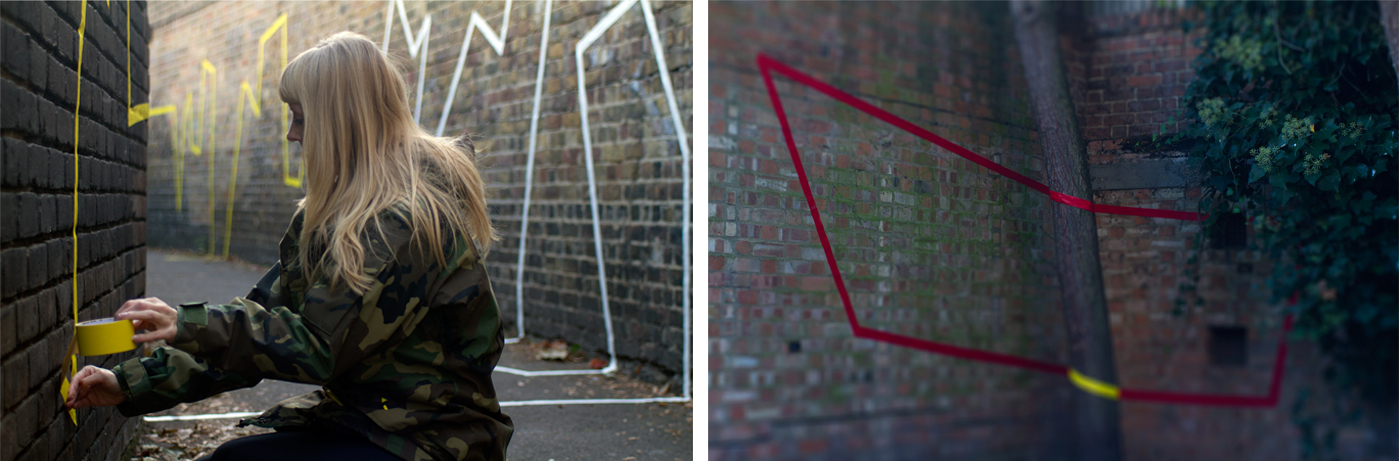 |
| Left: Creating the work, London SW11 Right: Future Cities (2011) |
Sunday, 6 November 2011
Studio Views: Work in Progress, Autosuggestion
 |
| Charley Peters, Autosuggestion (2011), Duct tape on wall |
Autosuggestion is the latest of my recent explorations of drawing with tape directly onto the studio wall. Although still being concerned with the repetition of parallel lines, Autosuggestion also explores geometric form and employs a wider colour palette than in previous tape drawings. This series will continue to develop in the studio over the successive weeks. More images of subsequent work will be posted on Carbon Particles when available.
 |
| Charley Peters, Autosuggestion (Detail) (2011), Duct tape on wall |
Studio Views: Work in Progress, Psychoparadoxa
 |
| Charley Peters, Psychoparadoxa (Work in Progress) (2011), Electrical tape on wall |
Psychoparadoxa are new works on the wall (above) and paper (below) that use the notion of perspective drawing as the starting point for geometric explorations of space. In these examples limited colour is used to both explain and confuse the separate planes of foreground and background.
 |
| Charley Peters, Psychoparadoxa (sketches) (2011), Pen on paper |
Monday, 17 October 2011
Project News: Future of the City
 |
| Work in progress for the Smart Urban Stage Future of the City project |
I have been invited to participate in an ongoing project dealing with the future of the city. Initiated by car manufacturers Smart, artists, designers, architects and technologists from different cities around the world are asked to question the urban status quo. Challenged to respond to a question, in this case posed by Gordon Wagener (Head of Design, Mercedes Benz), each project contributor must produce a series of 1-5 photographs as a means of communicating or exploring a notion of a 'future city'. I have been working on a response to Wagener's question, 'In reference to urban mobility (and Megacities) how will design evolve in the upcoming two decades?' My work, a series of drawn and documented interventions in locations around London can be seen online once published on the Future of the City website.
Previous contributions to the Future of the City project can be seen here: http://www.smart-urban-stage.com/
Further information about the project will be posted on Carbon Particles once the work is online.
Wednesday, 28 September 2011
Studio Views: Architectural Interruptions
 |
| Charley Peters, Untitled Wall Drawing (2011), Graphite on Wall |
Recent drawings in the studio has been developing the aesthetic concerns of the interrupted line. In a series of works on paper produced over the last few months parallel lines are systematically drawn but masked areas allow the lines to change direction and explore the resultant linear progressions. In Untitled Wall Drawing (2011), the architectural restraints of the corner of the studio replaces masking as the originator of the linear interruptions.
 | |||||||||||||||||||||||||||||||||||||||||||||||||||||||||||||||||||||||||||||||||||||||||||||||||||||||||||||||||||||||||||||||||||||||||||
| Left: Charley Peters, Praxis (Interrupted) (2011), Ink on Paper / Right: Charley Peters, Untitled Wall Drawing (Detail) (2011), Graphite on Wall |
Sunday, 18 September 2011
Studio Views: Work in Progress, Covariance Series
 |
| Charley Peters, Covariance (2011), Gaffer Tape, Canvas and Wall |
Another drawing with tape is being developed on the studio wall. The black and grey tape lines, of varying weights and widths, progress across the white wall, colliding with canvas squares and altering their trajectory.
Saturday, 17 September 2011
Studio Views: Work in Progress, Interrupted Vertical Lines
 |
| Charley Peters, Works in Progress (2011), Ink on Paper |
Developments of a new series of drawings incorporating interrupted vertical lines, drawn sytematically parallel to each other. The ink lines are layered in an unpremeditated manner, causing colours to mix on the paper.
Saturday, 10 September 2011


Studio Views: Moiré Drawings
 |
| Charley Peters, Moiré Sketch (2011) |
See also:
http://www.charleypetersprojects.com/2011/08/sketches-rupture.html and http://www.charleypetersprojects.com/2011/07/sketches-rupture.html
--
The word 'moiré' refers to visual interference patterns, which are created when two or more layers of simple dot, line, or grid structures overlap, producing an additional pattern on top of the original layers. Moiré patterns are often an undesired artefact of images produced by various digital imaging techniques, for example when scanning a halftone image, and is often an unwanted side-effect in printing processes.
The term originates from moire (or moiré in its French form), a type of textile characterised by a rippled or 'watered' appearance. In images, when two grids or series of parallel lines are overlaid at an angle, a similar effect is generated. The nonlinear interaction of the optical patterns of lines creates a visible pattern of roughly parallel dark and light bands, the moiré pattern, superimposed on the lines.
In a number of recent drawings from the series Rupture, I have generated moiré patterns through the layering of systematically produced lines. Generally speaking, instances of such visual disruption to images are generated unintentionally through the mechanical or digital processing of an image. As with all drawings rendered by hand, however, my drawings contain random deviations from a mechanically produced constant. Much of my recent work and research has similarly been characterised by such a dichotomy – the tension between the systematic and the uncontrollable, in both aesthetic and process terms, and references to the relationship between the mass-produced image and the unique object.
 |
| Charley Peters, drawings from sketchbook (2011) |

Thursday, 8 September 2011
TBC Artists' Collective: A Message To... Houston
 |
| Charley Peters, A Message To... Paul Neal 'Red' Adair (2011), Folded Paper on Wall |
TBC's latest project, A Message To... Houston has now been completed and images of the installation of the works by myself, Laura Davidson and Beverley Bennett are now available at 12-pages.com.
My collaboration with Davidson was inspired by research into the firefighter 'Red' Adair. Davidson interpreted a set of instructions supplied by me relating to a series of drawings made from folded paper for the project (above), which are installed in my studio in London. On the 25th of August Davidson recreated the works in Houston, Texas, and scattered their subsequently burned remnants along the park in the middle of Heights Boulevard, which divides the lanes of traffic travelling across town (below). The work is the latest in TBC's ongoing exploration of drawing as performative, interventionist or documentary medium, moving the act of solitary mark making out of the studio and into a collaborative, interactive environment. For more information about the project click here.
 |
| Laura Davidson and Charley Peters, A Message to Paul Neal 'Red' Adair' (2011) |
Friday, 26 August 2011
Exhibition News: Drawing Connections
 |
| Charley Peters, Sliver (2011), Ink on Paper |
The drawing Sliver (above) can be seen in the forthcoming exhibition Drawing Connections at the Siena Art Institute, Italy, from 24th September 2011. After the exhibition closes Sliver will remain in the permanent collection of the Siena Art Institute library.
Thursday, 25 August 2011
Studio Views: Work in Progress, Praxis Series
 |
| Charley Peters, from Praxis series (2011), Ink on Paper |
(Above) Recent drawings from the Praxis series of systematic repetitive line works, drawn on a smaller scale than other work in the series and exploring shifts in line direction, bleed between masked areas and visual movement created through line positioning. These finished drawings are developed from initial diagnostic works in my sketchbook, which can be seen in an earlier blog post.
Somnolence: Lines in Space
 |
| Charley Peters, from Somnolence series (2011), Graphite on Black Paper |
The Somnolence series of drawings based on intersecting lines is continuing to be developed in the studio. The example above shows the recent exploration of graphite on black paper to create a somewhat ghostly, semi-lustrous image, with asymmetric masking of the left and right sides of the drawing. Quick drawings in sketchbooks (below) suggest depth and viewing position through the proximity and position of the lines on the page, and illustrate the removal of tight masking from the upper and lower limits of the drawings present in earlier drawings in the series.
 |
| Charley Peters, sketches for Somnolence (2011), Ink and Marker Pen on Paper |
Grids and Non-Grids
 |
| Charley Peters, Untitled (2011), Ink on Paper |
Recent work in the studio has been exploring grids and the repetitive application of lines on and across such rigid structures. One example of these gridded drawings can be seen above, in this case successive straight lines are drawn in ink onto white paper. These drawings are still in development, but have led to further sketches where the grid is removed altogether (see below).
 |
| Charley Peters, Untitled Sketches (2011), Ink on Paper |
In these works the formal composition of the lines on the paper becomes important to suggest movement and harmony between the elements in the drawing - especially in the later exploration of materials where the lines are applied in a variety of media. The final examples shown here employ graphite, ink and paint in the same drawing, on both mid-tone grey papers (below) and semi-transparent paper (not shown).
 |
| Charley Peters, Untitled Sketches (2011), Graphite, Ink and Paint on Paper |
Sunday, 21 August 2011
Drawing is the New Painting
'Drawing is closest to the original kernel of an idea. Drawing is private. Drawing is the trace of a unique human subjectivity. Drawing returns us to narrative but without objectivity. Drawing always connects to writing. It links directly to literature, it is always a fiction. Drawing is irrational and rational, done on both sides of the brain. Drawing uses the newest digital technologies. It creates a virtual reality. Drawing is the foundation of all art departments, so important that it does not even need a concentration of its own. Drawing is very valuable, and must be shown only rarely, protected by glass. The more minimal, delicate, and ephemeral, the more poetic and evocative it is. The more obsessive, the more expressive it is. The more monumental, the more paradoxical and contemporary it is.
Drawing is the newest oldest medium. Drawing is impossible to define.'
from Kurczynski, K. Drawing is the New Painting. Published in Art Journal, April 2011
Drawing is the newest oldest medium. Drawing is impossible to define.'
from Kurczynski, K. Drawing is the New Painting. Published in Art Journal, April 2011
Sketches: Praxis
 |
| Charley Peters, Sketches for Praxis Series (2011), Ink on Paper |
The above exploratory drawings from sketchbooks illustrate some recent developments in the Praxis series of systematic drawings, using masking and angled lines to interrupt the drawn surface.
Subscribe to:
Posts (Atom)